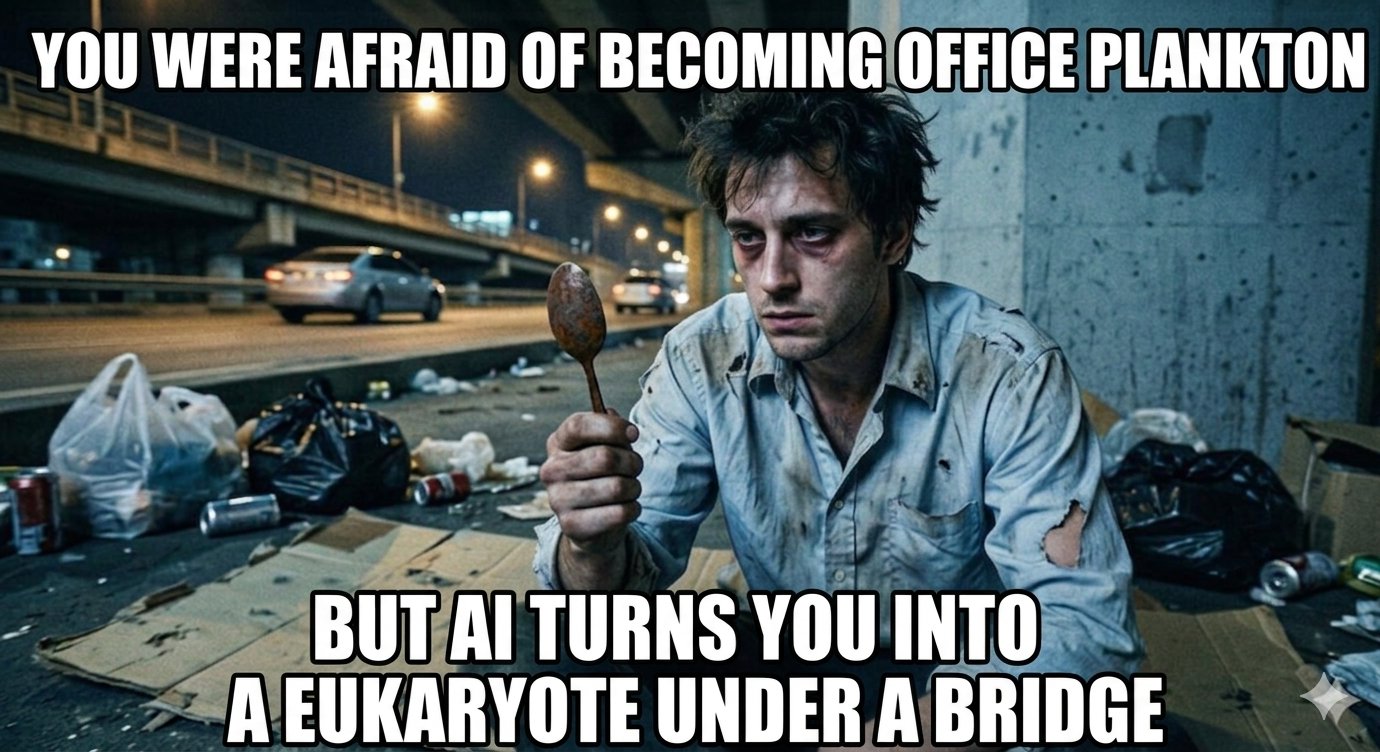
I finally got around to reading Shumer's viral post on AI. Here's my breakdown of the points he listed as a survival guide for "office plankton" in the current meta.
Start using AI seriously, not just as a search engine. Subscribe to the paid version of Claude or ChatGPT. It costs $20 a month.
my take
Sure, pay up. Spend your own money to train their model on your own data. I'm not saying boycott it — but let's be honest about how this is going to bite us later.
This year could be the most important of your career. Act accordingly. Learn these tools. Become a pro. Demonstrate what's now possible.
my take
It feels like sprinting toward the bow of the sinking Titanic. Sure, adapting might buy you another 5–10 years of employment. Right now we're in the validation phase. You aren't "creating" — you're a glorified proofreader for a machine. And eventually, the race for "Chief Human Overseer" will be won by whoever is willing to work for peanuts.
Drop your ego. Those who think their field is "special" or "immune" are in for a disappointment.
my take
No arguments here. Straight facts.
Get your finances in order. Build a safety net if you can.
my take
Facts. Part 2.
Think about where you are now and bet on what is hardest to replace.
my take
For years we were fed the fairy tale that technology would free up our time for "creativity and family." In reality, AI has just cranked up the speed of the hamster wheel. Now you're redlining just to stay in the same place.
Rethink what you tell your children. Teach them to be creators and lifelong learners, rather than pigeonholing them into a career path that might vanish by the time they graduate.
my take
The world doesn't need that many "creators." It feels like we're left with two chairs:
- The Physical World. Farmers, blue-collar workers, caregivers. A relatively safe harbor, but with a lower standard of living. It's much harder and more expensive for a robot to wipe a human's ass than it is to write code.
- The Elite. Raising a genius who can break into the inner circle running the whole show. Can't beat 'em? Lead 'em. But since those circles are gatekept, the first scenario is more realistic for most.
Also — "lifelong learning" is mostly BS. You can't argue with biology. An adult brain resists learning because it's physically expensive for the body to maintain that level of neuroplasticity.
Your dreams have become much closer. If you've ever wanted to create something but lacked the technical skills or the money — that barrier is practically gone.
my take
This is the ultimate fairytale. Anyone who has ever actually created something with the intent to monetize it has been slapped by the harsh reality of distribution. We live in an attention economy. The barrier isn't "making" the thing — it's getting a user to look at it. People are already flooding the App Store with identical habit trackers and AI social media automations. To be noticed, you either need a massive marketing budget or incredible organic reach.
Shumer wrote a survival guide. What I see is a guide to eventual self-liquidation.
Yes, right now AI doesn't always produce quality on the first try. Yes, AI content is still distinguishable from human-made stuff. But as I always say: don't judge AI too harshly — it's still just a toddler, and it's a fast learner.
Let's assume the main bottlenecks get solved. Given the billions investors have dumped into this and how aggressively executives are pushing AI automation — what are the odds this train slows down, even if visible results don't materialize immediately?
What's your take?